
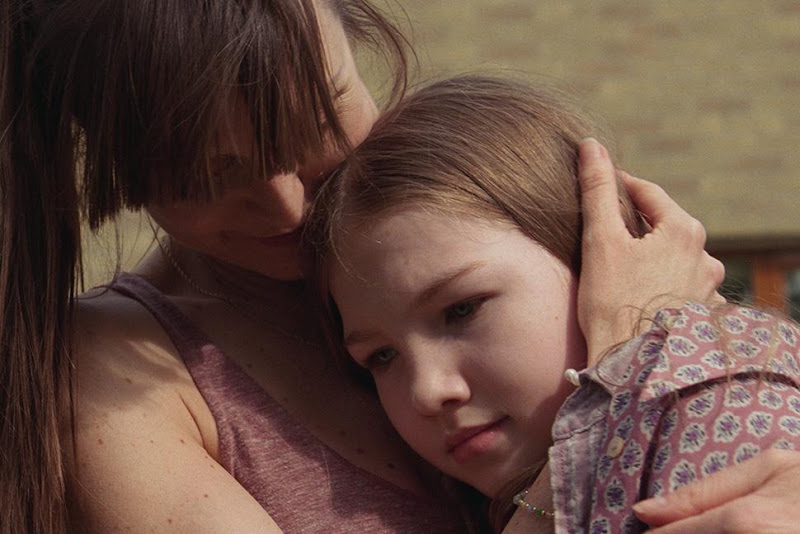
Saoirse Ronan’s directorial debut, Paper Plane, is a visually accomplished short film with some genuinely moving moments. But while I admired its aesthetics, I was left wanting more.
What initially looks like a mysterious opening, with a young girl seemingly dreaming, soon had me hooked. The mother (Clare Dunne) wakes up next to a man and goes into the kitchen, apparently distracted by worrying thoughts, when a paper plane lands in the kitchen sink. Inside is a note that reads: “I won’t come home until he is gone. If he stays, I go.” I immediately wanted to know what was happening in this family. Who was the man?
I didn’t initially realise that he was the girl’s father. Once I understood, the family dynamics made more sense, but I still wanted to know more about their relationship. Why did the daughter want him out of the house? And what had happened to bring things to this point? Introducing the central conflict through something as simple as a paper plane was moving and very effective.
The girl sending the paper plane to her mum is Fay (Martha Malone), a character of about 13, an age when relationships with parents can become increasingly complicated. I wanted a better understanding of what she had experienced and why she had reached the point of refusing to come home.
The paper planes are an effective storytelling device, particularly given their connection to Fay’s childhood and the notes she used to send her mother when she was little. Filmmakers are often told to show, not tell, and Paper Plane certainly does that. The images tell us a lot, but I still felt there was too much left unsaid. I wanted to understand the characters better and get a clearer sense of what had brought this family to this point.
I sometimes found the mother’s response to her daughter rather cold. Of course, family relationships are complicated, and we don’t know everything that has happened between them. But when your daughter makes such a desperate request, why remain so impassive? I wanted to understand more of what was going on beneath the surface.
Ronan’s director’s statement offers some insight into her intentions. She describes the film as a love letter to a younger version of herself and her mother, exploring how a child tries to make sense of circumstances beyond her control, and how love can exist alongside pain. The paper plane represents lost childhood and the desire for connection between two people who love each other but cannot find common ground. Knowing this, I can appreciate what Ronan was trying to achieve. But understanding a filmmaker’s intentions and experiencing those emotions while watching a film are two different things.
One thing I particularly appreciated was the casting. Both actresses bring authenticity and rawness to their characters. As an accomplished actress herself, Ronan clearly knows how to recognise talent and bring out strong performances. Thankfully, cinema still gives us real faces, imperfections and performances that feel human, rather than people who look as though they’ve been curated for an Instagram feed.
Watching Paper Plane also reminded me of Killing the Afternoon (2005), a short film by Margaret Corkery that made it into competition at the Berlin Film Festival. Margaret is an Irish filmmaker with a no-bullshit attitude whom I once shared a flat with in London in the mid-2000s. Although the two films are very different in subject matter, I recognised something familiar in their visual approaches: the carefully crafted shots, the way images unfold, and the feeling that there is something just beyond what we are being shown. Perhaps their shared Irish background is part of the connection I made, but Ronan’s visual style brought Margaret’s short film straight back to mind.
At around 15 minutes, Paper Plane tells a very visual story with little dialogue. I’m not sure it needed to be longer, and I don’t necessarily think it would work better as a feature. My problem isn’t its running time. I simply wanted to feel more connected to the mother and daughter and understand a little more about their relationship. Perhaps we’re not meant to have all the answers, and maybe that’s part of the point. Still, I found myself wanting to understand a little more.


