
The case of Szilvia Berki, Russell Brand and Jemima Goldsmith
A few years ago, I was invited to a private screening of a short film titled Sandstorm in Soho. The screening was followed by a Q&A with its director, Seemab Gul, and executive producer Jemima Khan, also known as Jemima Goldsmith.
Seeing Jemima at the screening brought back a memory from more than fifteen years earlier. She wouldn’t remember me, but I certainly remembered her. I had briefly served her as a customer when I was working at Harvey Nichols in London in the early 2000s.
Back in 2002, I was working on the Ladies International fashion floor at Harvey Nichols, Knightsbridge. The dresses there cost at least £1,000, and the clientele was wealthy. Jemima was one of them. A regular. I remember her because she was genuinely pleasant and polite. She didn’t behave as though the person serving her was beneath her. You would be surprised how unusual that could be in luxury retail. Just ask me, an ex-luxury retail shop assistant.
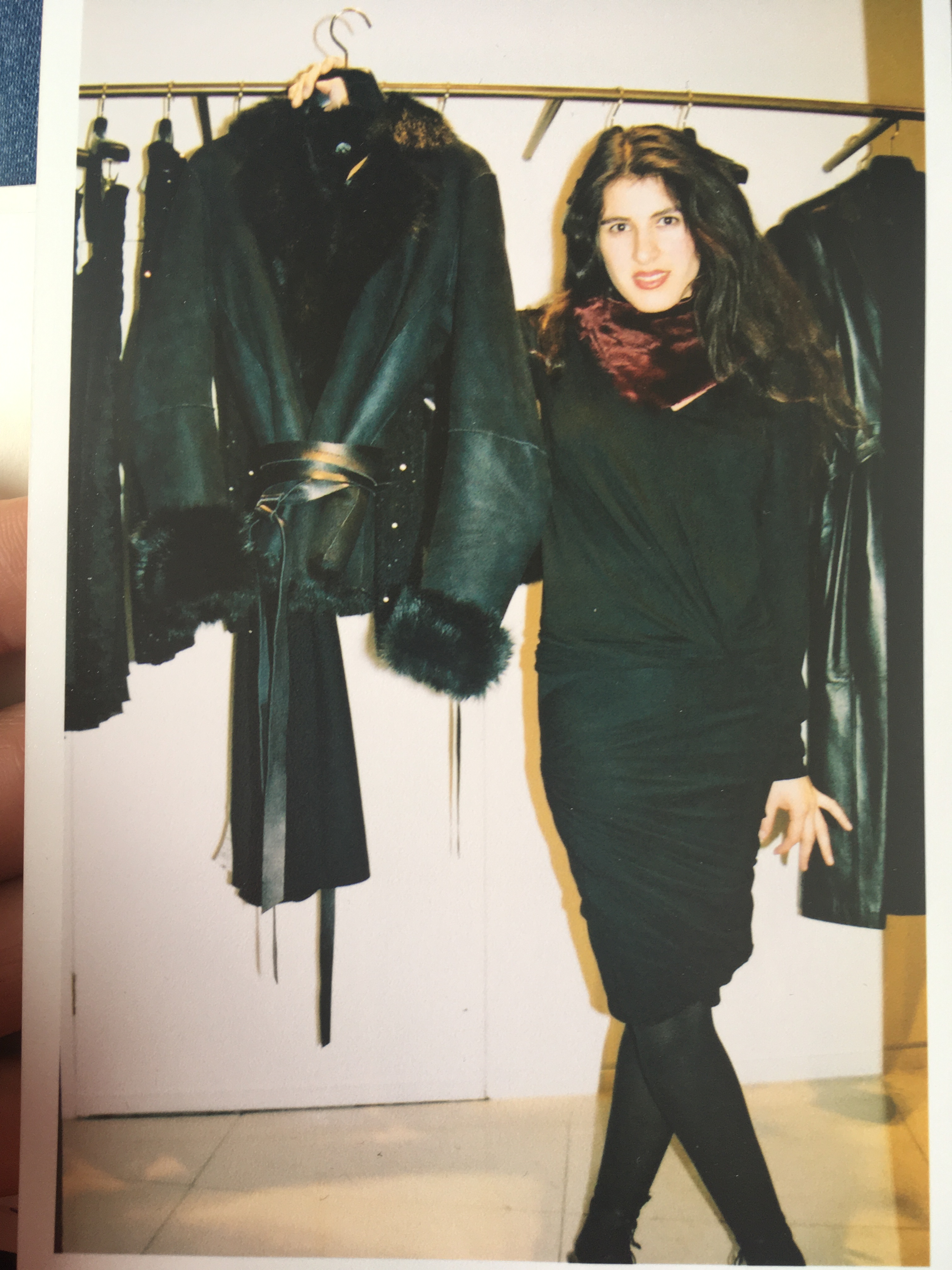
That’s me working in Harvey Nichols in the 2000’s , this was at the Donna Karan New York boutique at the Knightsbridge store
I remember processing her purchase. Behind me, on the till, there was a purple Valentino dress that was supposed to go back to the shop floor. She asked about the price. It was over £2,000, but it was a size M and she was an XS/S at most. She said, “Okay, I’ll take it.”
It was a fitted dress, made from stretchy fabric, and slightly too large for her petite frame. It probably didn’t fit particularly well, but for her, buying a dress at Harvey Nichols was rather like me buying a £10 dress from H&M. At the time, I was studying for my master’s degree at Goldsmiths and working to pay for it. For me, that amount represented several months of living expenses.
She paid for it and left. The interaction was respectful and polite, but the difference in our circumstances stayed with me. I could never have afforded to spend that much on a dress, let alone buy one that didn’t fit properly.
It was then that my manager, Ishrat, a London-based Pakistani woman, told me that Jemima was the daughter of a wealthy businessman called James Goldsmith and had been married to Imran Khan, a popular cricketer in Pakistan. My manager seemed to know a lot about her, but my younger self had no idea who either of these people were, nor did I particularly care. Back then, all I cared about was paying for my master’s degree and making films.
My manager seemed to have paid close attention to my interaction with Jemima, perhaps because she knew who she was. I was also told to smile a bit more when dealing with customers. Funny enough, my manager suggested I should style my long hair more, saying I didn’t do myself justice. It was a compliment of sorts, but also a rather passive-aggressive way of telling me that my appearance wasn’t quite right for Harvey Nichols. This was perfectly normal in the 2000s.
After that encounter, I saw Jemima in the press occasionally. She dated Russell Brand and Hugh Grant, but I wasn’t particularly interested, so I flicked past the headlines. Then, many years later, I saw her again in person at the Sandstorm screening.
By then, she was an executive film producer. She had also been a UNICEF ambassador for the UK and, at one point, editor of the New Statesman. Her background and the opportunities she had enjoyed made me think about how easily some people move through the worlds of film, media and public life.
In those industries, who you know can matter enormously. I know because I tried for years after leaving Goldsmiths. I worked in television production, in films and now in journalism. And it is not always what you know but who you know. When you don’t have those connections, getting commissions, getting films made and making a career for yourself becomes a million times harder.
What I did not expect, after seeing Jemima at that film screening, was that a few years later, following the highly publicised court case involving her former boyfriend Russell Brand, I would find myself questioning her part in the legal action against a woman who had accused him of sexual assault.
The case has come back into the spotlight following Brand’s conviction for rape and sexual assault, and an investigation by tax lawyer Dan Neidle.
On 7 November 2026, Neidle published his investigation into the case. The following day, he shared the injunction itself on social media, saying that this was the first time a copy of the order had been made public. He introduced it with the following summary:
“In 2014, a woman accused Russell Brand of assault. A court then banned her from ever talking about it, even to the police. She had no lawyer; there was no proper trial.”
You can read his investigation and see the injunction itself here: Russell Brand’s secret injunction – Tax Policy Associates. Neidle’s post on X also explains why he decided to publish the document.
I remembered the story vaguely. At the time, the press coverage presented it largely as a case of a massage therapist harassing Russell Brand and Jemima Khan. The impression was that this woman was causing them so much distress that they had little choice but to take legal action. But there are two sides to every story, and sometimes three. In this case, the woman’s account did not receive the same attention. She alleged that Brand had sexually assaulted her, as reported in the Hungarian press.
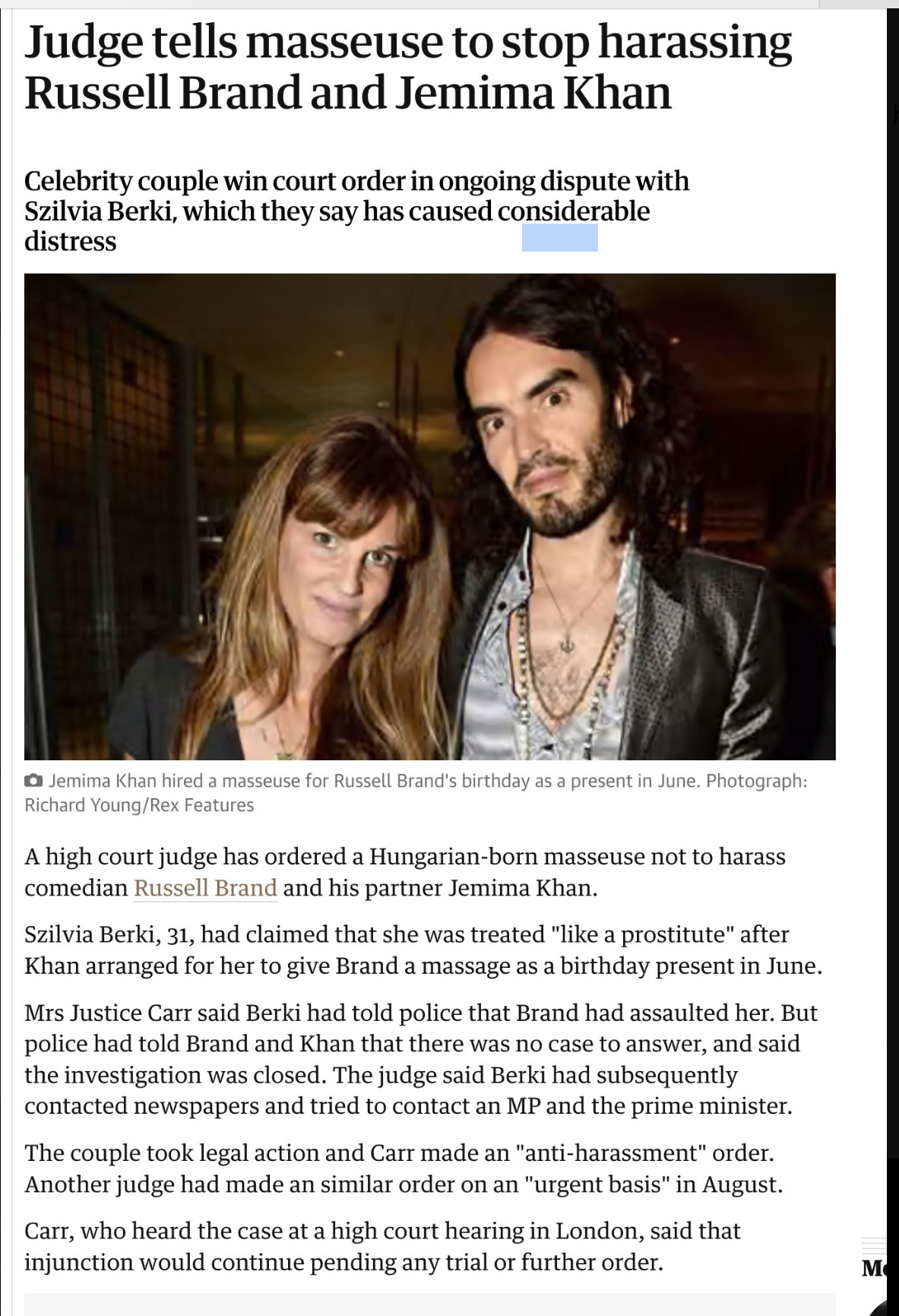
There is another side to this story, however, and it would be unfair not to acknowledge it. Jemima and Russell Brand said that Berki had harassed them and caused them anxiety and distress. We don’t know exactly how she behaved towards them, and we shouldn’t automatically assume that she did nothing wrong.
In fact, Jemima’s brother, Zac Goldsmith, has come forward on X to defend his sister, publishing examples of messages he says were among the hundreds shown to the judge. Some contain antisemitic abuse, threats and intimidating language directed at Jemima and her family. Zac Goldsmith argues that the injunction was an anti-harassment order, not a privacy order, and that it was necessary to protect his sister and her family. That is his position, and it deserves to be reported.
But the question goes beyond whether Jemima and Brand had a right to protection. Of course they did. It is whether the restrictions imposed on Berki were proportionate to the harassment alleged. The terms of the injunction appear to have prevented her from discussing the incident with journalists and others, and even from communicating further with the police.
According to accounts attributed to Berki and reported in the Hungarian media, Jemima Goldsmith contacted her to arrange a massage for Russell Brand as a birthday surprise. Berki was a Hungarian massage therapist. She was offered £500, including travel expenses, and went to Jemima’s country home.
When I read this, I couldn’t help thinking of Ghislaine Maxwell, who was involved in arranging massages for Jeffrey Epstein. I am not suggesting that the circumstances were the same, or that Jemima played a role comparable to Maxwell’s. The association simply made me uncomfortable. It made me think about the position of women who become intermediaries in arranging private encounters for powerful men.
Berki later alleged that what happened at Jemima’s country home was not what she had agreed to. Her account describes a situation in which Brand wanted her to move from the massage table to a double bed. She says he then began making sexual advances that were not part of the arrangement she understood herself to be accepting.
She reported the incident to the police, who took no further action. There was no criminal trial. We do not know whether her allegations about that particular encounter were true, and they were never tested at a full trial.
The subsequent civil proceedings raise questions about access to justice and the treatment of people without the financial means to defend themselves.
Russell Brand and Jemima Goldsmith brought a civil claim against Berki. The claim initially included libel but was ultimately pursued as harassment. In October 2015, an injunction was granted against her. Its restrictions went beyond preventing direct contact or harassment and placed significant limits on what she could say about the claimants and the incident.
This was not a wealthy woman with a team of solicitors behind her. She was representing herself against two high-profile claimants with access to substantial legal resources.
Even if Berki had behaved appallingly towards them, even if every message published by Zac Goldsmith is authentic, does that justify such extensive restrictions and the financial consequences that followed?
The court ordered her to pay £50,000 in legal costs within two weeks and authorised steps towards bankruptcy if she failed to pay. Whether or not anyone intended to bankrupt her, the consequences for a woman without the financial resources to defend herself were devastating.
An anti-harassment injunction should protect people from harassment. But there is a serious question about whether it should also prevent someone from discussing an alleged sexual assault, including with the police.
Berki challenged the order through the courts. In 2016, Lady Justice Arden raised concerns about aspects of the original judgment, including the absence of reasons for concluding that Berki had no defence. A renewed attempt was refused in 2017.
In September 2026, with the help of a pro bono lawyer, Berki sought to reopen the matter. Lady Justice Falk refused, but acknowledged that the injunction appeared to prevent further communication with the police and disclosures to treating doctors or therapists. She said the appropriate route was to apply to the High Court to vary the order.
Neidle also reports that Jemima has indicated she is amenable to the injunction being varied. That is relevant to what happens next, although it does not resolve the questions about the original order or the financial consequences for Berki.
Jemima Goldsmith and the British establishment
Jemima was not simply someone standing nearby. She was a claimant alongside Brand. She was part of the legal action that resulted in an injunction with far-reaching restrictions against a woman who had no legal representation and a demand for £50,000 in legal costs.
I am not suggesting that we know what Jemima knew about Brand’s intentions that day. We don’t. Nor can we say, on the information available, that she knew an assault had taken place or deliberately helped him conceal one.
But I do wonder whether she considered the imbalance between the parties. The same imbalance I remembered from all those years earlier: me, a student for whom £2,000 meant working extremely hard for several months to pay bills, university fees and living expenses; and her, spending more than £2,000 on an ill-fitting dress without apparently giving it a second thought.
She belongs to a world of wealth, influence, political connections and cultural access. She is part of the British establishment, and the establishment is very good at presenting itself as respectable. It has its charities, its cultural institutions, its public appointments, its dinner parties and its carefully managed public images. It knows how to speak the language of compassion, equality and social responsibility.
I also find it difficult to understand how a woman publicly associated with humanitarian causes and women’s issues could have been comfortable with an injunction whose terms appeared to prevent another woman from speaking about an alleged sexual assault, even to the police.
Russell Brand’s conviction does not settle Berki’s allegation
On 5 November 2026, Russell Brand was convicted at Southwark Crown Court of one count of rape and three counts of sexual assault involving four women. He was acquitted of two further rape charges and one charge of attempted indecent assault.
On 9 November, he was sentenced to ten years and six months in prison. These convictions concern offences between 2004 and 2009. They do not prove Berki’s allegation about the 2014 massage.
But the convictions do make the injunction story harder to dismiss as some obscure dispute from a decade ago. There is still a woman, Szilvia Berki, whose ability to speak about what she says happened to her is restricted by an injunction.
We don’t know what happened in that house in 2014. But there are questions about why a woman with so little money and influence could end up facing an injunction and such serious financial consequences after taking on two people with considerably greater resources and influence.
Justice should be the same for everyone, rich or poor. Otherwise, how can we claim to have a fair and equal system?


