
Szilvia Berki, Russell Brand, Jemima Goldsmith and the questions the injunction raises about access to justice
Updated 20:27, 9 November 2026: This article was updated after Jemima Khan published a statement on X giving her account of the events of 2014 and the injunction. Her account has been added, and some details have been corrected.
A few years ago, I was invited to a private screening of a short film titled Sandstorm in Soho. The screening was followed by a Q&A with its director, Seemab Gul, and executive producer Jemima Khan, also known as Jemima Goldsmith.
Seeing Jemima at the screening brought back a memory from more than fifteen years earlier. She wouldn’t remember me, but I certainly remembered her. I had briefly served her as a customer when I was working at Harvey Nichols in London in the early 2000s.
Back in 2002, I was working on the Ladies International fashion floor at Harvey Nichols in Knightsbridge. The dresses there cost at least £1,000, and the clientele was wealthy. Jemima was one of them. A regular. I remember her because of how casually she bought a dress when I served her at the till.
I clearly remember the purchase. Behind me, on the till, there was a purple Valentino dress that was supposed to go back to the shop floor. She asked about the price. It was over £2,000, but it was a size M, whereas she was an XS/S at most. It was on sale, so we didn’t have her size. However, she casually said, “I’ll take it.”
It was a fitted dress, made from stretchy fabric, and slightly too large for her petite frame. It probably didn’t fit particularly well, but buying a very expensive dress at Harvey Nichols seemed, for her, rather like me buying something from Poundland. At the time, I was studying for my master’s degree at Goldsmiths and working to pay for it. For me, that amount represented several months of living expenses.
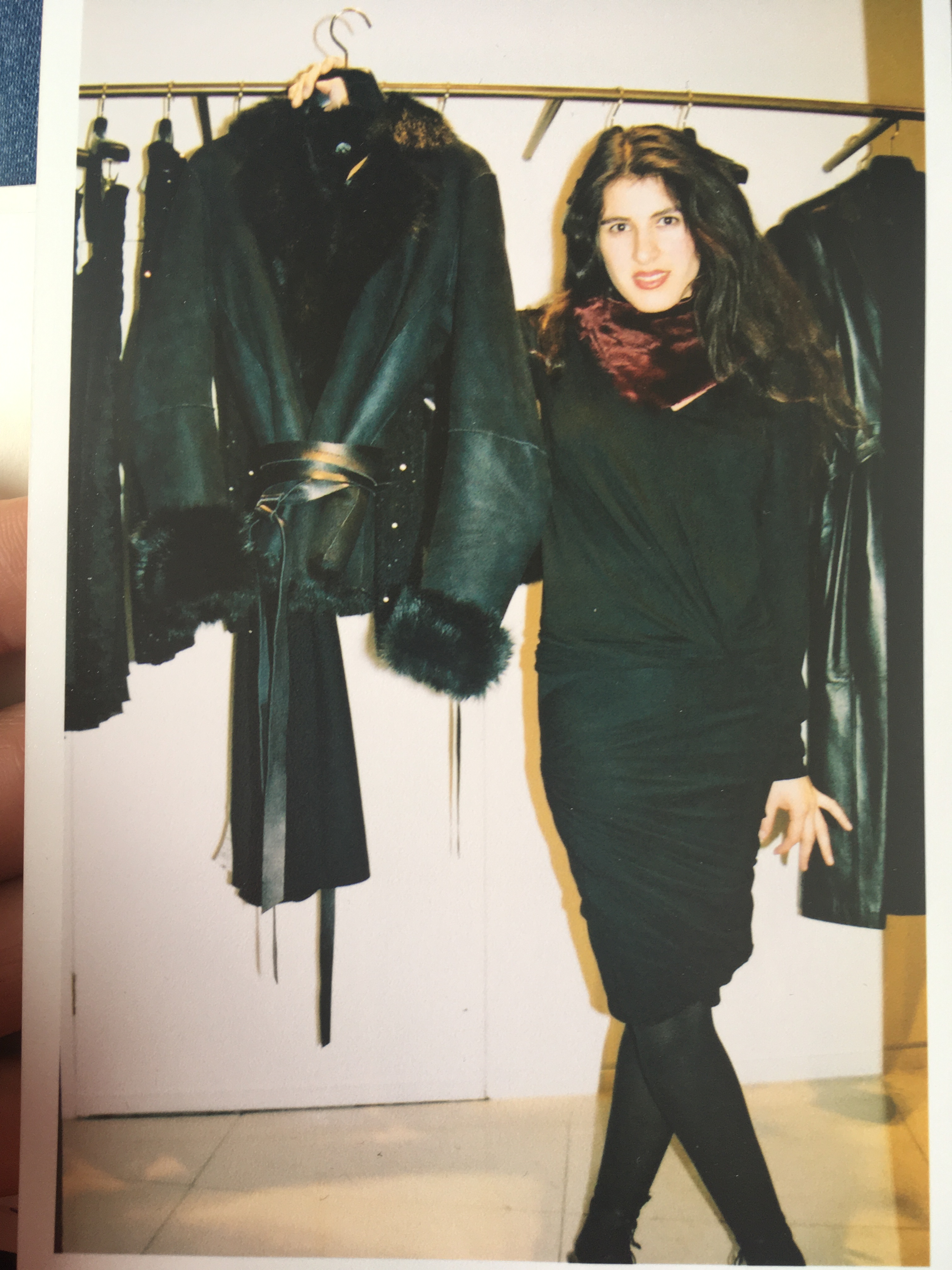
That’s me working in Harvey Nichols in the 2000s, this was at the Donna Karan New York boutique at the Knightsbridge store
She paid for it and left. It was then that my manager, Ishrat, a London-based Pakistani woman, came over to me and explained that Jemima had been married to Imran Khan, a very popular cricketer in Pakistan. Ishrat seemed to know quite a lot about her, but my younger self, in her early twenties, had no idea who either of them were, nor did I particularly care.
My manager seemed to have paid close attention to my interaction with Jemima, perhaps because she knew who she was. I was also told to smile a bit more when dealing with customers. Funnily enough, after talking at length about Imran Khan and Jemima, while my face was probably betraying my complete lack of interest (I had no idea who Imran Khan was, let alone anything about cricket, which wasn’t exactly popular in Spain, my home country), my manager suggested that I should do more with my long hair, saying I wasn’t doing myself justice. It was one of those backhanded compliments that really amounted to a dressing-down: apparently, my appearance needed some work if I was going to represent Harvey Nichols. This was perfectly normal in the 2000s.
After that encounter, I occasionally saw Jemima in the press. She dated Russell Brand and Hugh Grant, but I wasn’t particularly interested and would usually flick past the headlines. Many years later, however, I saw her again in person, this time at a screening of Sandstorm. By then, she was an executive film producer. She had also been a UNICEF ambassador for the UK and, at one point, associate editor of the New Statesman. Her background and the opportunities she had enjoyed made me think about how easily some people move through the worlds of film, media and public life.
In those industries, who you know can matter enormously. I know because I tried for years after leaving Goldsmiths. I worked in television production, in films and now in journalism. And it is not always what you know but who you know. When you don’t have those connections, getting commissions, getting films made and making a career for yourself becomes a million times harder.
What I did not expect, after seeing Jemima at that film screening, was that a few years later, following the highly publicised court case involving her former boyfriend Russell Brand, I would find myself questioning the terms of the legal action that she and Brand brought against a woman who had accused him of assault.
The case has come back into the spotlight following Brand’s conviction for rape and sexual assault, and an investigation by tax lawyer Dan Neidle.
On 7 November 2026, Neidle published his investigation into the case. The following day, he shared the injunction itself on social media, saying that this was the first time a copy of the order had been made public. He introduced it with the following summary:
“In 2014, a woman accused Russell Brand of assault. A court then banned her from ever talking about it, even to the police. She had no lawyer; there was no proper trial.”
You can read his investigation and see the injunction itself here: Russell Brand’s secret injunction – Tax Policy Associates. Neidle’s post on X also explains why he decided to publish the document.
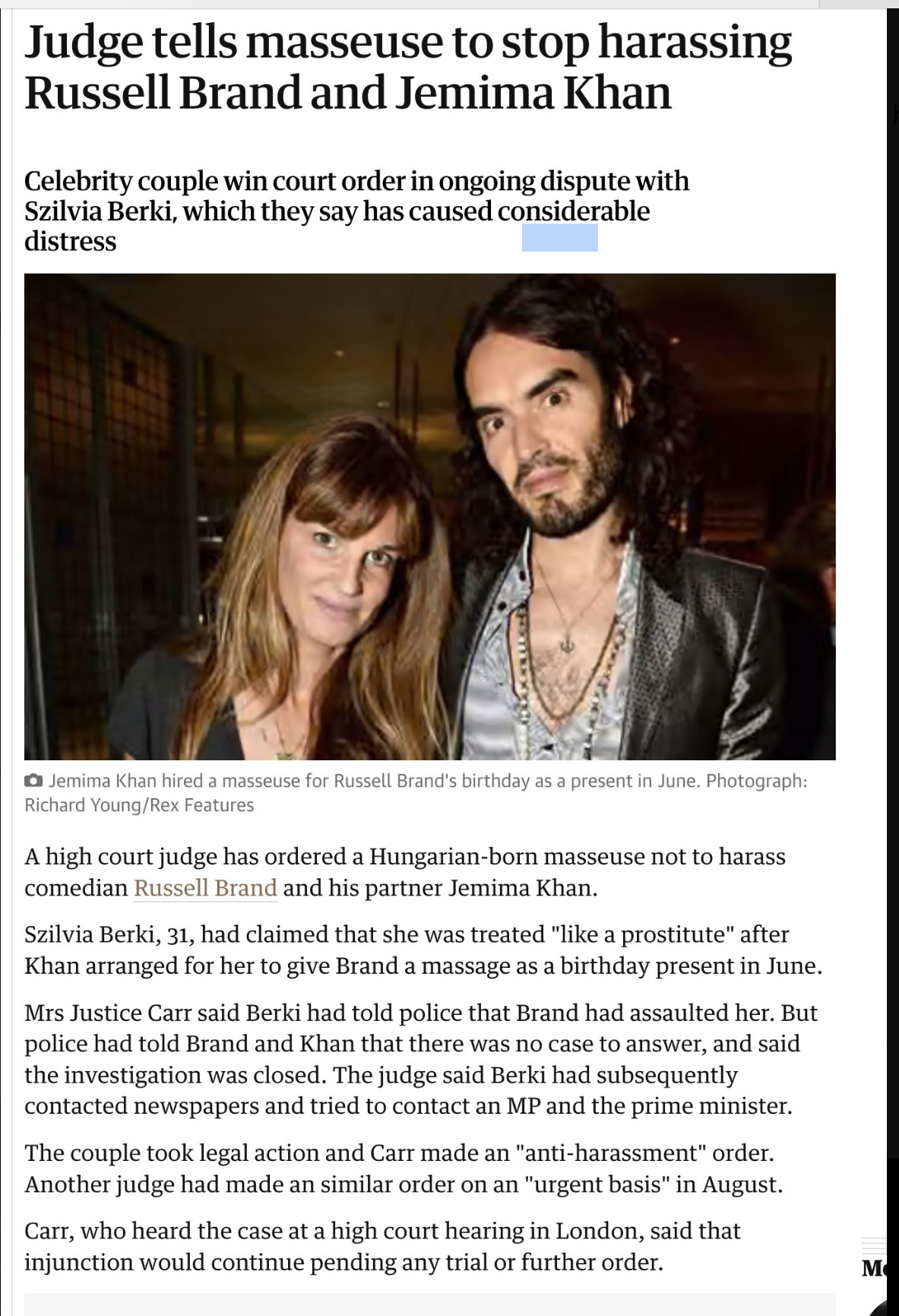
I remembered the story vaguely. At the time, the press coverage presented it largely as a case of a massage therapist named Szilvia Berki harassing Russell Brand and Jemima Khan. The impression was that this woman was causing them so much distress that they had little choice but to take legal action. But there are two sides to every story, and sometimes three. In this case, the woman’s account did not receive the same attention. She made a serious allegation against Brand, which was reported in the Hungarian press.
What happened in June 2014
The accounts of what happened that day differ, and none of them has been tested at a full trial.
According to accounts attributed to Berki and reported in the Hungarian media, Jemima Goldsmith contacted her to arrange a massage for Russell Brand as a birthday surprise. Berki, a Hungarian massage therapist, was offered £500 including travel expenses and went to Jemima’s country home. She later alleged that the encounter did not remain a massage: according to a Hungarian news report published in August 2014, Brand asked her to move from the massage table to a double bed and made sexual advances she says she had not agreed to.
Contemporary English-language coverage of her police complaint reported a more limited allegation — that Brand had pushed her as she left. The 2014 High Court judgment recorded that she alleged she was the victim of wrongful and criminal conduct, and, as reported at the time, that she had told police Brand had assaulted her.
Jemima’s account is different. In her statement on X she says she booked the massage, that Brand decided he did not want one and asked Berki to leave, that Berki was present for roughly half an hour, and that she herself was there throughout and saw nothing untoward. She also states that Berki never told the police she had been assaulted, threatened or falsely imprisoned. That is Jemima’s account of what the police told her.
Berki reported the incident to the police, who took no further action. According to Jemima, officers concluded there was no case to answer, and a later review by the IPCC and Thames Valley Police’s professional standards department upheld that decision. There was no criminal trial. Whether Berki’s allegations about that afternoon were true has never been tested in court.
The injunction
Jemima and Russell Brand said that Berki had harassed them and caused them anxiety and distress. In 2014 the High Court, in a judgment by Mrs Justice Carr, granted an interim anti-harassment injunction after being satisfied that the claimants were likely to establish that Berki had harassed them by accusing them of serious criminal conduct in the media, in emails to numerous people and in an online petition. A final order followed in 2015. We do not know exactly how she behaved towards them, and we should not automatically assume that she did nothing wrong.
Jemima’s brother, Zac Goldsmith, has published examples of messages he says were among the hundreds shown to the judge. Some contain antisemitic abuse, threats and intimidating language directed at Jemima and her family. He argues that the injunction was an anti-harassment order, not a privacy order, and that it was necessary to protect his sister and her family.
Jemima has now set out her own position. She says the messages, sent over many months, were frightening and distressing for her teenage children and her family, and that she feared Berki was a real danger to them. She says she agreed to the order, which she says Brand’s lawyer suggested, solely to stop Berki targeting her and her family. She also states that she herself experienced Brand’s violence, coercive control and abuse, that she called the police to have him removed from her house in 2014, and that she has not seen or spoken to him since.
The question is not whether Jemima and Brand had a right to protection from harassment. It is whether the restrictions imposed on Berki were proportionate. The order went beyond prohibiting direct contact. Its terms appear to have prevented her from discussing the incident with journalists and, on the face of the order, from further communication with the police. An anti-harassment injunction should protect people from harassment. There remains a serious question about whether it should also restrict someone from speaking to the police about an alleged assault.
The massage therapist was representing herself against two high-profile claimants with substantial legal resources. Even if every message produced to the court was authentic, the extensive restrictions and the financial consequences that followed still require scrutiny. According to Neidle’s investigation, the court ordered her to pay £50,000 in legal costs within two weeks and authorised steps towards bankruptcy if she failed to pay. The consequences for a woman without the means to defend herself were severe.
Szilvia Berki challenged the order. According to Neidle’s investigation, in August 2016 Lady Justice Arden refused permission to appeal on the papers because Berki’s written argument did not set out proper grounds, but she noted that Mr Justice Jay had not given any reasons for concluding that Berki had no defence. A renewed application, which Berki argued herself, was refused in March 2017 without reasons, and she was ordered to pay a further £2,000 in costs.
In September 2026, with pro bono assistance, Berki asked the Court of Appeal to reopen that refusal. Lady Justice Falk declined, saying the earlier concerns must be taken to have been addressed and that Berki had been properly heard. She did acknowledge that the injunction appeared on its face to prohibit further communication with the police and disclosures to treating doctors or therapists, and said the proper route was an application to the High Court to vary the order.
Jemima now says she agrees the order should be varied. She states that her lawyer informed Berki’s barrister of this in December 2025 so that Berki could speak to the police again if she wished. She says Berki’s barrister has not responded since May 2026, and that any variation also requires Brand’s agreement, which she cannot compel. This is her account. It is relevant to what happens next, but it does not resolve the questions about the original order or the costs consequences for Berki.
Jemima Goldsmith’s role in the case
Jemima was not simply someone standing nearby. She was a claimant alongside Brand. She was part of the legal action that resulted in an injunction with far-reaching restrictions against a woman who had no legal representation and a demand for £50,000 in legal costs.
I am not suggesting that we know what Jemima knew about Brand’s intentions that day. We don’t. Nor can we say, on the information available, that she knew an assault had taken place or deliberately helped him conceal one. Her own account is that she saw nothing untoward, and that she herself was a victim of Brand’s violence.
What stays with me is the imbalance between the parties. Berki had no lawyer. The claimants had the resources to pursue her through the courts. A claimant’s reasons can be sincere, and the order can still go further than it should.
Russell Brand’s conviction does not settle Berki’s allegation
On 5 November 2026, Russell Brand was convicted at Southwark Crown Court of one count of rape and three counts of sexual assault involving four women. He was acquitted of two further rape charges and one charge of attempted indecent assault.
On 9 November, he was sentenced to ten years and six months in prison. These convictions concern offences between 2004 and 2009. They do not prove Berki’s allegation about the 2014 massage.
But the convictions do make the injunction story harder to dismiss as some obscure dispute from a decade ago. There is still a woman, Szilvia Berki, whose ability to speak about what she says happened to her is restricted by an injunction.
We don’t know what happened in that house in 2014. But there are questions about why a woman with so little money and influence could end up facing an injunction and such serious financial consequences after taking on two people with considerably greater resources and influence.
Justice should be the same for everyone, rich or poor. Otherwise, how can we claim to have a fair and equal system?


Ms Berki has no family members in the British establishment to speak up for her, which is unfair. Silencing people for life is outrageous. Good read
LikeLike
Hopefully we will hear from Berki soon. As for Jemima, read her statement , it clarifies a lot.
LikeLike
Regardless of what her family says, she helped crush of one of his victims (Berki) and she stayed silent.
LikeLike
Her statement clarifies a lot though. The link is in my post. That said, we haven’t heard Berki side of the story because she can’t .
LikeLike
Thank you for sharing, quite interesting
LikeLike
Thanks for reading Bella x
LikeLike